A cat, a mech, and the ability to turn into a mouse sound like a recipe for a quirky Metroidvania. Bolt of Whalington is more thoughtful than that. Orca Studio’s demo impressed us with how closely exploration follows the protagonist’s abilities. There’s charming artwork, a playful personality, and a couple of ideas that feel genuinely worth developing further. Combat left us with more questions, particularly when it comes to movement and avoiding damage, but that doesn’t overshadow what the demo gets right. Its systems are what make it worth watching.
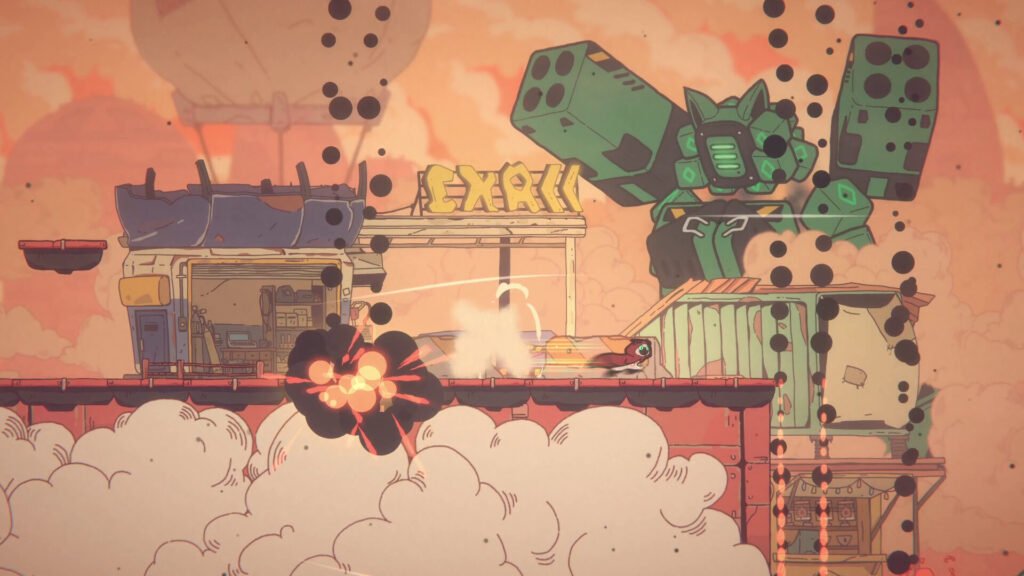
Bolt is a cat exploring Whalington, a floating city full of strange inhabitants and interconnected passages. As in any Metroidvania, new abilities open new routes. The interesting part is how the game treats Bolt’s various forms. As a cat, he can move around freely, while the mech provides a more powerful but less agile alternative. Its additional weapons also open up different ways to approach obstacles and encounters. The environments demand both forms, so deciding when to use the mech becomes part of navigation. That makes the choice more meaningful than simply picking the stronger character for a fight.
The most unusual mechanic goes a step further by letting you change the rules governing the world and even Bolt himself. During the demo, you can turn him into a little mouse and slip through tunnels that are too narrow for his normal feline body. It changes how you read the environment. A tiny gap might be a route rather than decoration, and an apparently inaccessible area invites you to think about transformations instead of simply waiting for a standard upgrade. The game’s Rule Terminals can also change objects; the mouse already shows their potential. Crucially, it fits into the map rather than feeling tacked on. Spotting where that unusual ability might help becomes part of the puzzle.
Combat is a little harder to judge positively. Bolt’s basic form relies on melee attacks, while the mech adds its own close-range moves, a hook that can reach targets at a distance, and a limited supply of projectiles that can be replenished at designated stations. That creates practical reasons to choose between forms during fights. Limited ammunition also means thinking about when to shoot and when to save your supplies until the next refill station. Our concern is the defensive side, especially in more demanding fights.
The dash in this demo is a movement burst rather than a conventional dodge. It doesn’t grant invulnerability frames, and you can’t pass straight through enemies with it. Instead, you have to pay closer attention to spacing, positioning, and when it’s safe to commit to an attack. That can work if enemy patterns and arenas are built around the limitation. We’re curious how it will work against tougher bosses. The difficulty of what we played was fairly moderate, well below the challenge associated with Hollow Knight or Silksong. For now, exploring Whalington is more enjoyable than fighting through it.
Visually, the game is a delight. Its hand-drawn cartoon art gives the environments a warm, playful quality, and the character designs are full of personality. The world is full of amusing details. Some of the enemies sound especially adorable, too. Their effects bring a smile to your face before you’ve even decided how to fight them. Even the sound design supports the playful tone. That lighthearted mood sets it apart from darker Metroidvanias.
Bolt of Whalington’s smartest idea is a world designed around its transformations, making every change of form part of the puzzle. If you enjoy Metroidvanias for the pleasure of discovering new routes, the demo gives you plenty of reasons to pay attention. Players who prefer demanding, technical combat may be less convinced by its defensive options. Orca Studio has a promising foundation here, and we’re curious to see what it builds on top of it.