


Onimusha: Way of the Sword: What Critics and Players Think
18 professional reviews cross-referenced with the first 500 Steam user reviews ranked by helpfulness · Steam data through 8 September 2026
The strongest agreement around Onimusha: Way of the Sword is unusually clear: its sword combat and marquee bosses are the reason the revival works. Critics and Steam players repeatedly praise the same risk-and-reward language of parries, deflections, dodges and Issen. The dispute begins outside those fights, where Kyoto, repeated mini-bosses, light progression and side content turn a focused action game into a longer, less consistent one. The central question is not whether the combat is excellent, but how much repetition that excellence can absorb.
Consensus map
Where press and players meet
| Aspect | Press | Players | Relationship |
|---|---|---|---|
| Sword combat | Exceptional, precise and expressive | The clearest recurring strength | Strong positive consensus |
| Main bosses | Spectacular mechanical highlights | Frequently treated as the game’s peak | Strong positive consensus |
| Enemy and mini-boss variety | Too limited for the runtime | Reuse and passive mobs recur heavily | Negative consensus |
| Kyoto and side content | Less convincing than linear stages | Often seen as repetitive padding | Broad negative consensus |
| Difficulty | Accessible, with disagreement over challenge | Easy mobs, stronger later bosses | Same phenomenon, different weight |
| Musashi and cast | Expressive and charismatic | Strongly praised across languages | Positive consensus |
| Progression | Thin beside the combat system | Weak rewards amplify repetition | Broad consensus |
The player column reflects an expanded qualitative sample of 500 public Steam reviews ranked by helpfulness; the percentages shown later use complete Steam aggregate totals by review language. The 500-review sample is not statistically representative of the full Steam corpus.
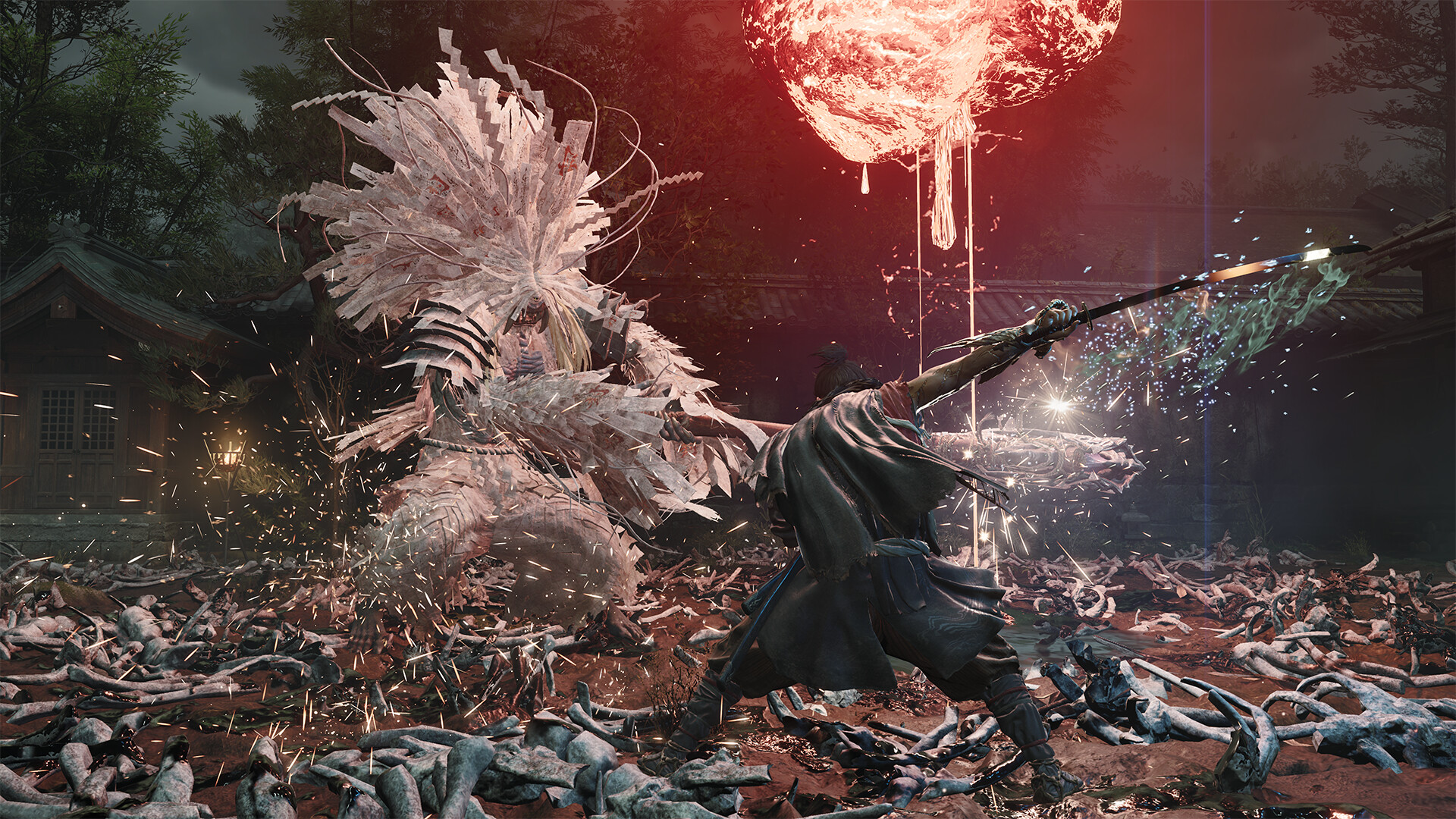
A sword system that turns defense into expression
Across the international press, the most stable argument concerns the combat itself. PC Gamer, Gamekult, GamerSky and IGN all describe a system whose depth comes less from long combo strings than from choosing the right response at the right risk level. Blocking is safe, parrying and deflecting create more advantage, a well-timed dodge changes tempo, and Issen turns attack timing itself into a counter.
Skill Up makes the underlying design especially clear: Onimusha invites mastery without requiring it. A player can take the slower, safer route through an encounter or compress the same fight by using higher-risk counters. That reading is strongly echoed in the 500-review Steam sample, where experienced action players repeatedly distinguish Onimusha from a pure Sekiro imitation even when they use Sekiro as the closest shorthand.
This also explains why arguments about difficulty are so inconsistent. The game does not only ask whether an enemy is hard to survive; it lets the player choose how ambitious the response should be. Several Steam reviews that call ordinary enemies easy still praise the pleasure of pursuing Issen timing or perfect counters. Others want the game to force that sophistication more aggressively. Both readings can be true because the combat system contains more difficulty than the baseline encounter tuning always demands.
Bosses unlock the system; ordinary enemies often hold it back
The main bosses are where critical and user reception align most completely. GameSpot treats the best encounters as a major reason the combat belongs among the top tier of modern action games, while GRYOnline.pl, Inven and Skill Up similarly emphasize the way spectacle and mechanical readability reinforce one another. The strongest bosses ask for the whole defensive vocabulary without turning their presentation into a substitute for interaction.
Steam strengthens that conclusion but exposes the opposite problem more sharply. A recurring complaint across English, Chinese, Japanese and other languages is that ordinary enemies are too passive, sometimes visibly waiting their turn in groups. That matters more here than in a conventional hack-and-slash because so much of Musashi’s strongest offense begins with an enemy action. When basic foes hesitate, a combat model built around reading and answering attacks can collapse into much simpler first-strike cleanup.
Enemy variety compounds the issue. Professional reviews from Everyeye, GamePro and Inven already flagged the limited roster; the 500-review sample makes repeated mini-bosses one of the clearest user complaints, including among enthusiastic recommendations. The result is a striking asymmetry: individual boss design can be exceptional while the broader encounter ecosystem still feels understocked.
How much repetition can exceptional combat absorb?
Kyoto is the point where the revival’s ambition becomes its biggest liability. Gamekult, Jeuxvideo.com, SpazioGames, GamerSky and GameSpot all prefer the authored linear stages to the semi-open hub, where backtracking, cleansing routines, collectibles and modest side quests increasingly expose repeated content.
Steam does not merely repeat that criticism; it helps explain why progression makes it worse. Many players describe upgrades as small numerical improvements and side rewards as weak, yet some of those materials and skill unlocks are useful enough to encourage engagement with activities they otherwise would skip. This creates an awkward loop: the optional structure offers too little transformation to make repetition exciting, while still providing enough character growth to make total avoidance feel suboptimal.
This is why raw runtime is less informative than density. Famitsu and CD-Action are comfortable with, or positive about, the game’s volume; other critics imagine a much tighter 10–15-hour action game. The expanded Steam sample points to the same fault line. Some players welcome extra fights because the combat remains pleasurable even against recycled opponents. Others argue that every return trip makes the scarcity of new enemies, meaningful rewards and bespoke encounters harder to ignore.
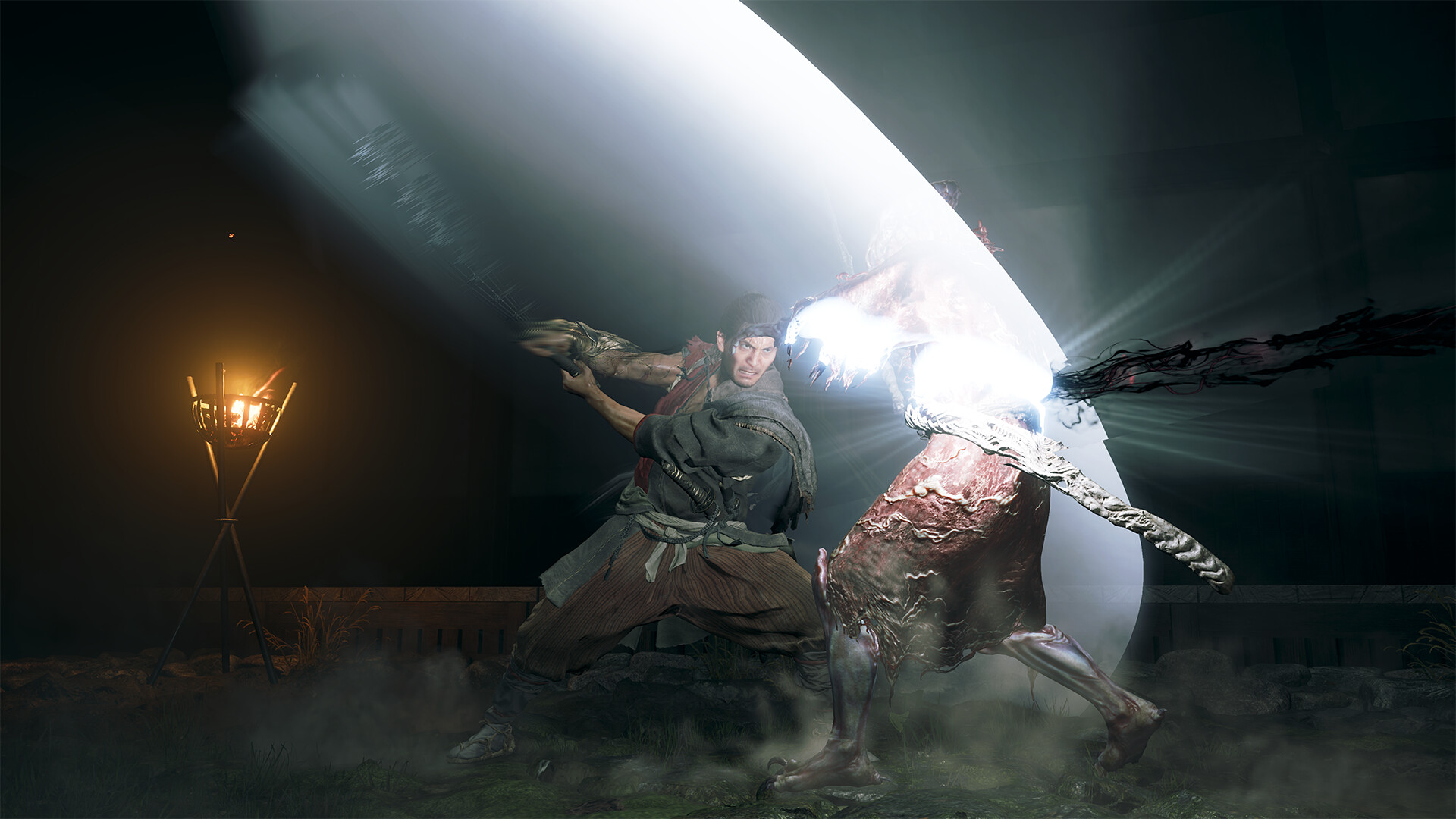
Musashi gives the revival a personality of its own
If the combat supplies Onimusha’s mechanical identity, Musashi supplies its human one. Famitsu, Game*Spark, Inven and CD-Action all give unusual attention to character performance. Skill Up goes further, arguing that the Toshiro Mifune-inspired face, broad physical acting and roguish humor make this Musashi feel distinct from the more stoic samurai protagonists that dominate modern games.
The 500 Steam reviews reinforce this more strongly than expected. Musashi’s expressions, swagger and comic timing recur across languages, as does praise for the supporting cast and Japanese voice performances. The plot itself is less consistently admired: some players find it straightforward or thin but still value the characters, villains and tone. That distinction closely mirrors GRYOnline.pl’s view that the story is simple while the personalities make it watchable.
The horror also helps separate the game from the comparisons surrounding its combat. Skill Up highlights body horror and psychological cruelty rather than Resident Evil-style B-movie scares, while the official premise places Malice-corrupted Kyoto and the Genma at the center of the setting. The result is a tonal mixture of grotesque imagery, theatrical villainy and humor that many users regard as more distinctive than the plot mechanics themselves.
A modern Onimusha, but not the same Onimusha for every veteran
The professional press generally sees the modernization as successful. A9VG explicitly frames the game as an attempt to adapt an early-2000s formula to contemporary expectations, while GRYOnline.pl argues that the result preserves enough identity to avoid becoming a generic Soulslike. Steam adds a more substantial dissenting voice from long-time fans.
That dissent is not reducible to nostalgia. Some veterans specifically miss the older games’ denser puzzle-box structure, true equipable weapon progression, Dark Realm-style challenge spaces, greater survival-horror pressure and concise replayability. Others, equally familiar with the series, describe Way of the Sword as exactly the return they wanted. The relevant relationship is therefore “users divided”: the revival succeeds as a modern action game more consistently than it succeeds at matching every player’s definition of what Onimusha used to be.
A smaller player-led criticism concerns guidance. Repeated tutorial pop-ups, puzzle hints and companion commentary can feel overprotective in a game whose combat otherwise trusts players to learn timing through observation. It is not a dominant professional complaint, but it recurs enough in the larger sample to matter as part of the broader tension between accessibility and mastery.
PC performance is broadly strong, with specific launch frictions
The PC picture is more positive than the usual high-profile launch pattern. Across the 500-review sample, users on a wide range of hardware repeatedly report stable frame rates and good optimization, and the official Steam listing provides comparatively modest recommended hardware for 1080p/60 with upscaling. This makes performance itself a player-led strength rather than a major source of disagreement.
There is, however, a narrower cluster of PC-specific complaints: startup or loading crashes on some configurations, missing or inconsistent DualSense vibration and haptic behavior, limited controller remapping, FOV or camera preferences and isolated visual-readability complaints. These reports are real within the sample but should not be inflated into universal defects. As of 8 September 2026, Capcom’s official Steam news feed contains launch and preload notices but no post-launch patch note documenting fixes for those issues, so this analysis does not present any of them as officially resolved.
The distinction matters because the overall technical consensus is favorable. The evidence supports “strong optimization with configuration-specific rough edges,” not “a broken PC port” and not “problem-free for everyone.”
Share of positive reviews. Only language groups with at least 100 reviews are shown, ordered by review count.
Steam total: 11,121 reviews through 8 September 2026, 88.6% positive. The qualitative analysis uses 500 public reviews ranked by helpfulness. Chinese combines Simplified and Traditional Chinese; Spanish combines Spain and Latin America; Portuguese combines Portugal and Brazil. Review language does not indicate a player’s nationality or location.