


Mewgenics: What Critics and Players Think
15 professional reviews cross-referenced with the first 1,000 Steam user reviews ranked by helpfulness · Steam data through 14 September 2026
Critics and players agree on one thing: Mewgenics is extremely deep. Its classes, items, mutations, breeding, and random events keep creating new builds and new problems for hundreds of hours. The real disagreement is about control. Some players love having to deal with bad luck; others feel that a long run can be ruined by events they had little chance to prevent.
Consensus map
Where press and players meet
| Aspect | Press | Players | Relationship |
|---|---|---|---|
| System depth | Very deep and full of interacting systems | A main reason to keep playing | Strong agreement |
| Build variety | Constantly creates new combinations | Still surprising after very long playtimes | Strong agreement |
| Randomness and control | Can be exciting or unfair | Players are clearly divided | Main disagreement |
| Cost of losing | Long runs make failure painful | Time, cats, gear, and recovery can all be lost | Players give it more weight |
| Breeding and house | Deep but sometimes awkward to manage | Rewarding for some, tiring for others | Same issue, different weight |
| UI and readability | Hard to read at launch in some situations | Better now, but still demanding with many cats | Broad agreement; patches helped |
| Music and humour | Music widely praised; humour more divisive | Music strongly praised; humour splits some players | Mostly positive agreement |
The player column reflects a qualitative sample of 1,000 public Steam reviews ranked by helpfulness; the percentages shown later use complete Steam totals by review language.
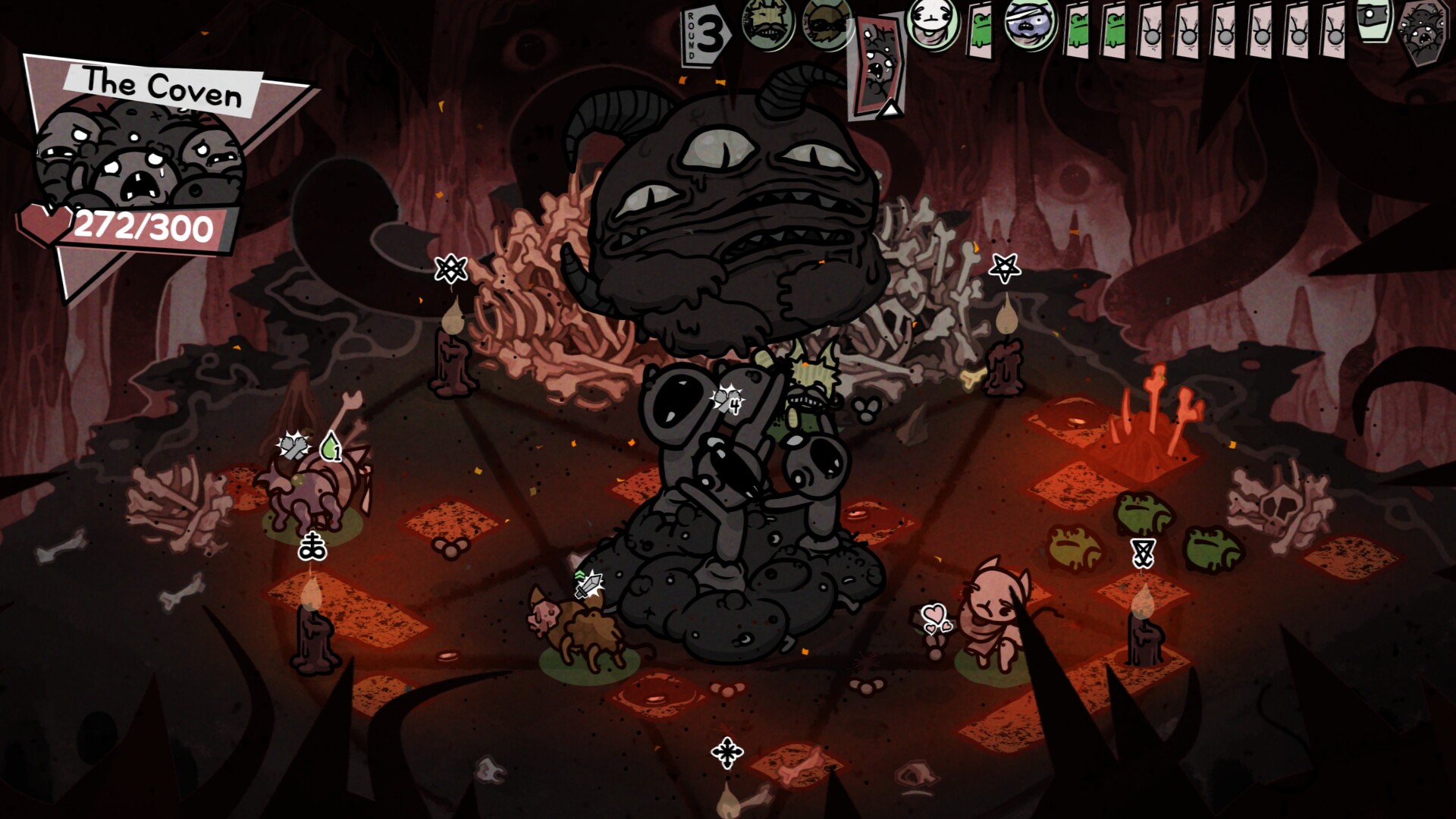
Deep systems that keep changing the game
The strongest point of agreement is simple: Mewgenics is not just big, its systems constantly affect each other. GameSpot praises the way classes, gear, breeding, and long-term progress work together. PC Gamer points out that random skills and stats stop familiar classes from feeling the same every time. Jeuxvideo.com reaches a similar conclusion: the game keeps creating new situations instead of repeating the same tactical puzzle.
The Steam sample says much the same thing. Players with very long playtimes still talk about finding new abilities, mutations, items, and team combinations. They also remember individual cats, failed runs, lucky combos, and family lines because those stories came from their own campaign rather than from a fixed script.
IGN explains this well. Items wear out, starting abilities are uncertain, and individual cats do not stay active forever. These limits stop one strong strategy from solving the whole game. Steam reviews often praise the same idea: a good plan matters, but sooner or later the game forces you to change it.
This is why the large amount of content matters. Critics and players both say that new enemies, skills, items, and mutations keep appearing for a long time. On this point there is very little disagreement: Mewgenics has enough variety to support a very long campaign.
The big divide: when randomness feels unfair
The main disagreement is about how much control the player should have. PC Gamer accepts that some bad luck is part of the fun because it can turn a run into a memorable story. Gameswelt makes a similar point: a disaster can suddenly become a clever recovery. IGN also enjoys having to work with an imperfect hand instead of choosing everything in advance.
Other critics are less forgiving. GamesRadar+ says some chains of random events give the player too little chance to respond. VGTimes goes further and argues that careful breeding and planning can lose too much value when luck decides the outcome. 3DNews takes almost the opposite view and finds the overall balance strong.
Steam players are divided in the same way. Many positive reviews say that dealing with bad luck is the point of the game. Negative or mixed reviews usually make a more specific complaint: randomness is fun when it creates a problem to solve, but not when an unavoidable event removes an important cat, ruins a long plan, or ends a run before the player had a fair chance to react.
The current version also matters. The May 1.1 update changed several events, disorders, abilities, and balance values, and removed some especially harsh results. So not every launch complaint still describes the game exactly as it is today. The wider debate remains, because uncertainty is still a central part of Mewgenics.
Breeding is smart, but managing the house gets tiring
Breeding is one of the ideas that makes Mewgenics stand out. A cat is not only a fighter for the next run. It can pass on a mutation or class ability, become breeding stock, join a family tree, or be traded for permanent upgrades. Gamekult shows how combat, genetics, and house upgrades feed into each other. GameSpot and Vgmag.it also see breeding as a major part of the game’s long-term depth.
The problem is how much work it can take. IGN criticises the lack of a really convenient overview once the house is full of cats. GameSource and Vgmag also point to interface and readability problems. Game Informer is more negative and finds the house management less interesting than the battles.
Steam players give this problem even more weight. Many love the family histories created by injuries, mutations, and inherited skills. But players with very long playtimes often ask for better lists, filters, sorting, and faster ways to manage a large population. The developers later acknowledged that house management becomes difficult after roughly 250 hours and said a free update was being prepared for long-term play.
So the problem is not that breeding lacks depth. The problem is that the tools used to manage it do not always keep up with how large the system becomes.

Losing hurts because runs can cost a lot of time
Critics often call Mewgenics difficult, but most still see that difficulty as part of its appeal. CD-Action praises the hard tactical battles while warning that luck can be cruel. Gamekult accepts much of that harshness, while VGTimes sees real balance problems. IGN adds an important detail: later runs can last around two hours.
Steam reviews put more focus on what happens after a loss. A bad run can cost more than the run itself. Players may lose valuable gear, cats, quest progress, breeding work, and the real time needed to rebuild. For some users, that is the point where difficulty stops feeling exciting and starts feeling exhausting.
This explains why some players praise the combat but still leave very negative reviews about progression. They are not always asking for easier enemies. They want the punishment for losing to feel more closely tied to what they could have known or controlled.
The same split appears around save-scumming and systems that punish it. Some players like the fact that choices have real consequences. Others feel that slow recovery adds another punishment after the run has already been lost. The real argument is therefore about time, not simply difficulty.
Patches helped, but the game is still dense
Some launch reviews criticised readability and missing information, but several of those problems have been improved. A February patch made tall scenery semi-transparent in tactical view and fixed inventory sorting. Another update improved how cats are selected and grouped in the house. IGN also noted before launch that mutation information and other UI details had already become easier to check.
These fixes remove some early complaints, but they do not make Mewgenics a simple game. A single battle can involve mutations, gear effects, environmental rules, turn order, status effects, and enemy abilities at the same time. PC Games sees the steady introduction of these systems as a strength. GameSpot and GamesRadar+ are more concerned that some important information arrives only after the player has already started making important choices.
Steam players sit between those two views. Many enjoy learning a complicated game and do not see complexity as a flaw. Their main complaint is practical: when they need to manage dozens of cats or understand why a complicated chain of effects happened, the interface does not always make the answer easy to find.
The May 1.1 update also changed events, breeding rules, class balance, tooltips, and inventory behaviour. The current version is clearer than the launch build, but it still asks the player to remember a lot.
A strong style that some players will hate
Mewgenics has a very clear personality. Its cats are cute, disposable, sick, mutated, sexual, violent, and often surrounded by bodily fluids. Most critics enjoy this tone or simply treat it as a matter of taste. Game Informer is the strongest exception and argues that the jokes and stereotypes become tiring over such a long game.
Steam reviews show that this criticism is not unique, but it is still a minority view. Some players love the tactical game but dislike the humour; many others think the gross comedy is part of its charm. The music is much less divisive. Critics and players regularly praise individual songs, boss themes, and the way each area sounds different.
Localization makes the language data harder to read. Japanese, Korean, Russian, and Simplified Chinese support only became public on 5 September 2026, months after the PC launch. Some older negative Chinese-language reviews in the sample are mainly about delayed or imperfect localization. The Ukrainian group is also unusually negative, and several reviews there focus on language support. Review language should not be read as nationality or as a simple regional verdict on the game itself.
Even so, the main picture stays the same. Players may dislike the humour, the house management, or the way a run can fall apart, while still praising the combat and the huge number of possible interactions. Mewgenics divides people more on the price of its ideas than on the quality of the core tactical system.
Share of positive reviews. Only language groups with at least 100 reviews are shown, ordered by review count after Playority's required language-group merges.
Steam total: 53,813 reviews through 14 September 2026, 89.9% positive. The qualitative analysis uses 1,000 public reviews ranked by helpfulness. Chinese combines Simplified and Traditional Chinese; Spanish combines Spain and Latin America; Portuguese combines Portugal and Brazil before thresholding and ranking. Review language does not indicate a player's nationality or location.