


Mortal Shell II: What Critics and Players Think
16 professional reviews cross-referenced with the first 100 Steam user reviews ranked by helpfulness · Steam data through 7 September 2026
Professional coverage is unusually consistent about Mortal Shell II being a major improvement over its predecessor, but that apparent agreement hides an important divide. Critics and Steam players broadly admire the stamina-free combat, the much stronger identity of the Shells, and the freedom to construct powerful builds. Players are markedly harsher, however, on what happens when those systems are stretched across the full game: repeated enemies, erratic difficulty, navigation friction, and a second half whose bosses and encounter design do not always keep pace with the strength of the underlying combat.
Consensus map
Where press and players meet
| Aspect | Press | Players | Relationship |
|---|---|---|---|
| Combat feel | A major improvement: aggressive, weighty, and more responsive | One of the most consistently praised elements | Strong positive consensus |
| Shells and builds | Distinctive and unusually flexible | Highly valued; launch progression restricted experimentation | Broad consensus; patches reduced friction |
| Exploration | Mostly rewarding, dense, and much improved | Split between engrossing discovery and exhausting navigation | Same qualities, different weight |
| Enemy variety | Mixed: sufficient for some, repetitive for others | Repetition remains a persistent complaint, especially later | Players are substantially harsher |
| Bosses | Strongly divided | Also divided, with late bosses attracting the sharpest criticism | Persistent disagreement |
| Difficulty and balance | Flexible but inconsistent | Can swing from punishing to overpowering and back again | Consensus on inconsistency, not on difficulty level |
| Story | Cryptic and secondary to the action | Usually weak or incidental; Shell memories fare better | Broad consensus |
The player column reflects a qualitative sample of 100 public Steam reviews ranked by helpfulness; the percentages shown later use complete Steam totals by review language.
A sequel that finally owns its combat identity
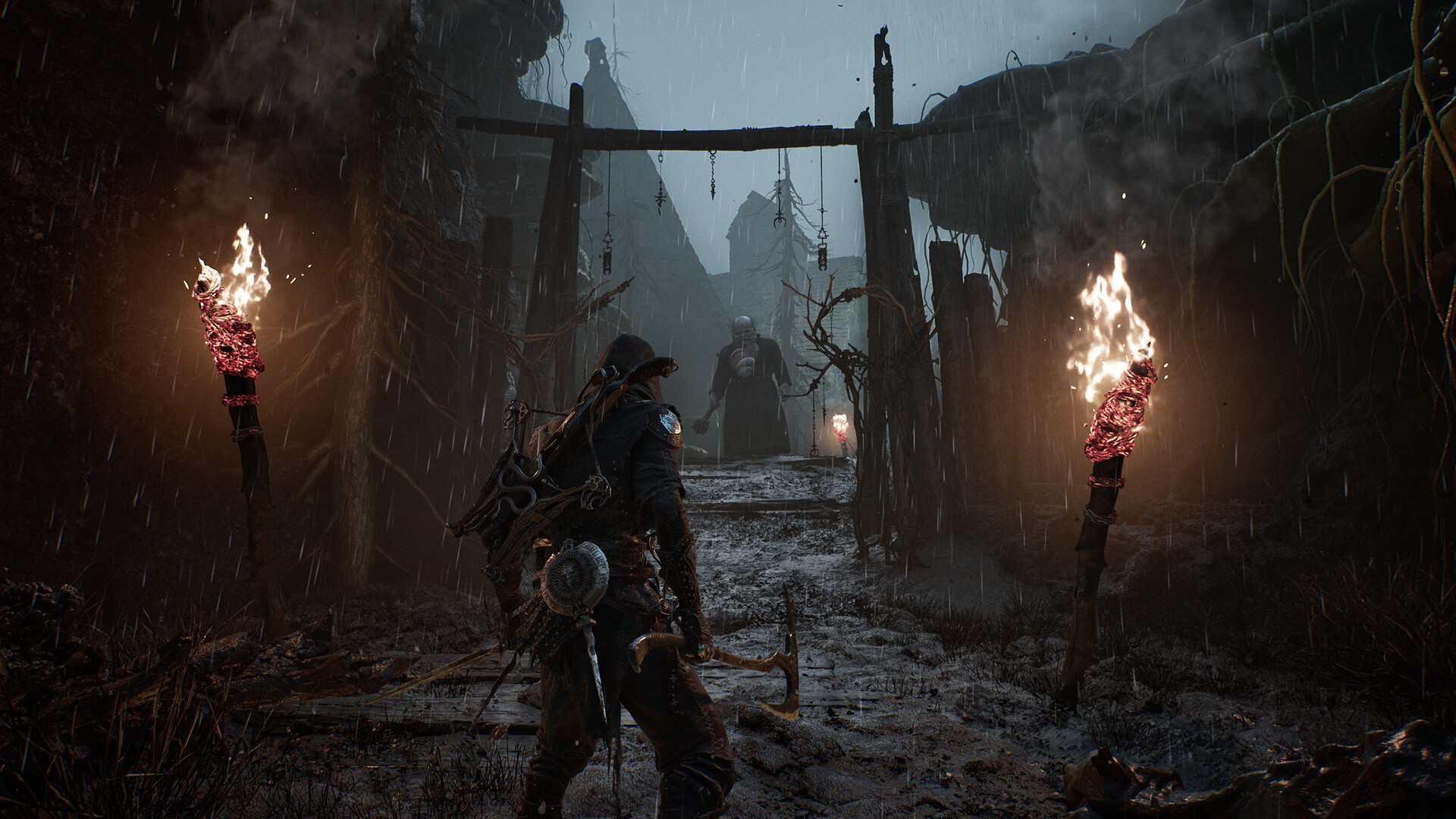
The clearest international consensus is not simply that Mortal Shell II is better than Mortal Shell, but that Cold Symmetry has turned the original game’s isolated ideas into a more coherent combat language. GameSpot, IGN, Tom’s Hardware Italia, and SpazioGames all identify combat as one of the sequel’s most substantial advances.
Removing stamina changes the rhythm immediately: attacks, dodges, and movement no longer stop because a bar has emptied, but long animations and the inability to cancel careless commitments still punish indiscriminate aggression.
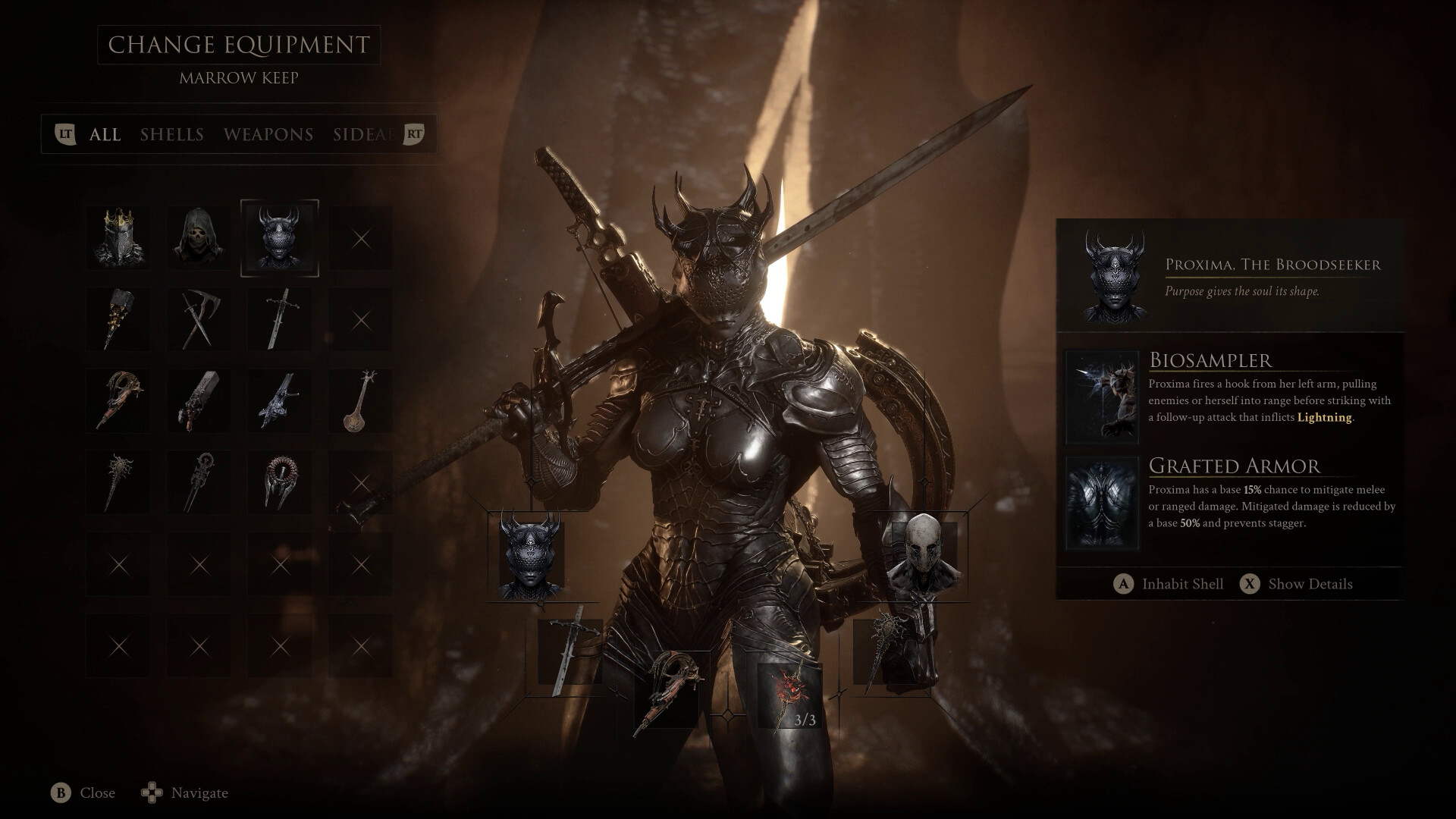
The Shell system benefits even more from the redesign. Where the first game often differentiated bodies through statistics and passive bonuses, the eight Shells now possess active abilities capable of changing how a fight is approached. Famitsu particularly values the freedom to rebuild a Shell around a difficult encounter, while IGN stresses how stealth, stagger attacks, damage mitigation, and other specialist abilities make switching bodies mechanically meaningful. Seals add another axis by turning Harden, conventional guarding, and different forms of parrying into selectable defensive philosophies rather than mandatory universal mechanics.
The new Steam sample strongly reinforces this assessment. Praise for attack weight, finishers, parries, Shell abilities, movement, and the absence of stamina appears even inside some highly critical reviews. That distinction matters: many of the harshest players are not rejecting the combat system itself, but arguing that later encounters fail to make the best use of a system they otherwise enjoy.
Some launch complaints now require historical context. Early Steam reviews repeatedly describe extreme enemy tracking, attacks that seemed to pull enemies towards the player, weak riposte damage, and uneven heavy-weapon performance. The official Week 1 Update subsequently gave ripostes a full scaling pass, restricted enemy tracking and magnetism, rebalanced heavy weapons, refined bosses, and introduced a broad range of combat fixes. Several users later edited their reviews to mark individual complaints as fixed. Launch reports therefore remain useful for reconstructing initial reception, but they should not be treated as an unchanged description of the current PC build.
Build freedom is real, but progression once fought against it
Weapons, sidearms, Shell abilities, Seals, and Tarstones create the other major point of agreement. Giant Bomb sees the freedom to assemble extremely powerful configurations as part of Mortal Shell II’s appeal rather than a defect to be disciplined out of the game. GameSpot reaches a similar conclusion about the breadth of possible builds, while IGN describes the combination of Shell and weapon as the real foundation of a playstyle.
The result is less about choosing a conventional strength or dexterity archetype than about assembling interactions between active skills, defensive rules, status effects, ranged tools, and resource generation. The launch version nevertheless created a contradiction between that promise and its progression economy. GameSpot and Gram.pl questioned the availability of upgrade resources, while launch-period Steam reviews repeatedly complained that finite Glimpses, Tarstone investment, and the cost of moving upgrades discouraged experimentation precisely when new equipment was still being discovered.
This is one of the clearest cases where the current game has moved beyond the reviews published at launch. The Week 1 Update made Glimpses and Tarcores renewable, introduced a Shell respec item, revised rewards and merchant stocks, and explicitly made it possible to upgrade all Shells and Tarstones in a single playthrough. Multiple Steam reviewers subsequently edited earlier criticism to acknowledge the change.
The underlying balance question remains. Users still describe large gaps between weapons and Shell combinations, and once an efficient build comes together the middle game can become dramatically easier. IGN notes that an optimized build can outpace later challenges; PPE.pl similarly questions whether unlimited stamina and strong configurations occasionally remove too much resistance. The issue is therefore no longer whether players are allowed to experiment freely, but whether encounters scale intelligently around the power that experimentation can produce.
An open world that rewards curiosity and tests patience
The move to a larger interconnected world is the sequel’s most visible expansion. GameSpot praises its density and the way individual regions retain the texture of designed levels rather than becoming large empty fields. Numerama compares the pleasure of wandering off-course favourably with Elden Ring, while StopGame values a structure where weapons, Shells, secrets, and unusual spaces are found through curiosity rather than by clearing a checklist.
Steam is much more divided. Enthusiastic reviews describe losing hours to hidden paths, beacon dungeons, small puzzles, and the urge to inspect one more cave. Others see almost the same geometry as a maze of branches with weak landmarks, repeated scenery, and detours whose rewards do not justify the effort. IGN reaches a related conclusion about the map: it provides orientation, but lacks the sort of annotation that would make abandoned points of interest easy to remember.
Checkpoint placement magnified that disagreement at launch. PC Games criticises the distance between some beacons, and early Steam reviews often identify long runbacks as the moment exploration turns from adventurous to punitive. The Week 1 Update added new beacons, altered exploration rewards, and removed or shortened specific return routes. Updated Steam reviews explicitly acknowledge the improvement, so the most extreme launch descriptions no longer represent the whole current picture.
What remains is structural rather than purely logistical. Even after additional checkpoints, a large part of the experience depends on whether deciphering Fallgrim’s geography is satisfying in itself. Game*Spark is one of the strongest advocates for the expanded format; SpazioGames is more cautious about the rhythm created by alternating free exploration and dungeon-like spaces. The Steam sample reproduces both positions almost exactly, making the world one of the clearest examples of press and players describing the same qualities while assigning them different weight.
The second half is where the praise fractures
The strongest recurring argument in the Steam sample is not visible in professional scores themselves: a large part of the most detailed user criticism describes a deterioration after an excellent or promising opening. Early regions introduce Shells, weapons, enemies, and discoveries at a rate that makes the world feel dense; later regions increasingly reuse opponents, raise health or damage, combine familiar enemies in larger groups, and rely on encounter types the player has already learned. Even many favourable reviews concede that the second half contains less novelty than the first.
This is also where the professional sources disagree most. GameSpot considers the enemy roster broad enough that variants rarely become a serious problem. GamePro, PC Games, 3DM, and iXBT Games are substantially less forgiving, pointing to repeated enemies, simple patterns, or a late-game structure that substitutes numerical pressure for new mechanical ideas. The 100-review Steam sample gives considerably more weight to this harsher interpretation.
Difficulty itself is not the consensus. Some players become powerful enough to dismantle bosses rapidly once a Shell and Tarstone combination comes together; others describe ordinary late-game enemies capable of removing most of a health bar. Several reviews contain both experiences in the same playthrough: a punishing opening, a middle section dominated by a successful build, and a final stretch whose enemies regain the advantage through health, damage, tracking, or numbers.
The distinction matters because this is not simply a complaint about length. A smaller enemy roster can work if later encounters recombine it in mechanically richer ways. The recurring Steam argument is that Mortal Shell II too often changes the quantity, durability, or damage of familiar opponents instead. Numerical balance can be patched — and has already changed substantially — but the amount of genuinely new enemy behaviour in the second half is a more structural limitation.
The 5 September update adds an important new layer to this discussion on PC: an experimental Adaptive Difficulty option can raise or lower enemy damage, health, and break resistance according to player performance. It is optional and off by default, and its adjustments relax back towards the standard balance over time. That makes it a new tool for smoothing or intensifying the difficulty curve, but it does not invalidate criticism of the default tuning, nor does it create the missing enemy or encounter variety identified by the harsher reviews.
Bosses are more memorable to look at than they are to judge
No theme produces a cleaner contradiction between professional sources. Jeuxvideo.com treats bosses as one of the adventure’s strengths, praising encounters that can provide satisfying tests. iXBT reaches almost the opposite conclusion and regards the boss roster, especially towards the end, as one of Mortal Shell II’s principal failures. PC Games occupies the middle ground: visual concepts can be striking, but patterns are often simple and difficulty can derive more from damage values than mechanical complexity.
IGN helps explain why those reactions can coexist. Its review finds some bosses and creatures visually remarkable while acknowledging that they are not always the most interesting combat situations. Steam reviews repeatedly draw the same distinction: grotesque silhouettes, unusual concepts, finishers, and spectacle are praised more consistently than the mechanics of individual encounters.
The final portion attracts the sharpest criticism. Helpful reviews in several languages single out late bosses for tracking, grabs, high damage, large health pools, camera problems, or mechanics that sharply reduce room for error; other players describe those fights as the few encounters capable of forcing an overpowered build to adapt. The Week 1 patch substantially reworked or corrected several bosses, including hitboxes, attack timing, tracking, double-damage bugs, and one-shot behaviour, so launch complaints about specific broken attacks require qualification. What persists is the broader disagreement over whether the late bosses achieve difficulty through readable mechanical complexity or through numerical pressure.
Strong PC performance and rough launch polish are not the same thing
The technical picture is unusually platform-dependent. GamePro applied a technical penalty to its PS5 assessment after encountering stuttering and bugs, while Gram.pl reports problems on Xbox Series X. PPE.pl, by contrast, describes PC optimisation positively. The Steam sample reinforces that latter position: many users explicitly praise frame-rate stability and Unreal Engine 5 performance, sometimes on hardware below the top end.
Good performance does not mean the launch was polished. The same 100-review sample contains reports of crashes, audio problems, broken interactions, geometry issues, characters getting stuck, unreliable targeting, camera failures in confined spaces, and progression-related bugs. Experiences vary sharply: some players encountered repeated crashes, while others completed long runs with few or no serious technical interruptions.
The official Week 1 Update is therefore essential when reading launch reviews retrospectively. It added new beacons, Shell respec, progression and economy changes, combat adjustments, boss and weapon refinements, restricted tracking and magnetism, performance work, and a substantial number of stability fixes. Several Steam reviewers later edited their own posts to identify individual complaints as resolved.
The 5 September PC update continued that process with Adaptive Difficulty, further combat and balance adjustments, additional bug fixes, and technical changes. Mortal Shell II still attracts current complaints about camera behaviour and isolated bugs, so the present build cannot simply be described as technically clean; equally, the loudest launch-specific failures should not automatically be presented as unchanged current problems.
The most human stories belong to the bodies you borrow
Narrative is one of the areas where disagreement is relatively limited. Game*Spark criticises the density of terminology and the difficulty of intuitively understanding the world, while Jeuxvideo.com and StopGame similarly find the central narrative too cryptic or too weakly foregrounded. Numerama is more comfortable allowing that obscurity to function as atmosphere, but even the more positive readings do not place the main plot among the game’s strongest achievements.
The Shell memories fare better. Famitsu values the way investment in a Shell gradually reveals the life associated with that body, and IGN likewise finds those individual histories more grounding than the larger mythology. Steam players repeatedly make the same distinction: the broad objective and cosmology may remain vague even after completion, while memories, smaller NPC interactions, and the recognition of particular Shells provide more immediate character texture.
Art direction carries much of the weight that conventional storytelling does not. Across professional reviews and the Steam sample, grotesque enemy designs, diseased landscapes, ruined architecture, blood-heavy finishers, and a deliberately ugly strain of dark fantasy are among the most dependable sources of praise. The world may be difficult to parse narratively and, for some players, spatially, but it rarely lacks a visual point of view.
Share of positive reviews. Only language groups with at least 100 reviews are shown, up to a maximum of ten, ordered by review count.
Steam total: 18,553 reviews through 7 September 2026, 77.7% positive. The qualitative analysis uses 100 public reviews ranked by helpfulness. Review language does not indicate a player’s nationality or location. Chinese combines Simplified and Traditional Chinese; Spanish combines Spanish and Latin American Spanish; Portuguese combines Portuguese and Brazilian Portuguese.