
The Legend of Zelda: Ocarina of Time — Beyond the Reviews
12 professional reviews from 1998–99 · one contemporary essay · 2,741 distinct Metacritic user-review texts · data through 2 October 2026
Ocarina of Time is a 3D action adventure: you guide Link through Hyrule, fight with a sword and tools, and solve dungeons as both a child and an adult. Its appeal comes from learning how places work and returning with equipment that opens new routes. We compared what we consider leading international press reviews from its original release period with 2,741 distinct user-review texts from Metacritic. The later accounts reinforce the praise for its temples and atmosphere, but put more pressure on waiting, travel and guidance. Its reputation makes sense; it does not make those interruptions disappear.
Consensus map
Where press and players meet
Original-release criticism and later user accounts describe different moments in the game’s life. Here is where their arguments meet.
A major step forward for fighting in 3D.
Effective targeting; less agreement about speed.
TakeawayClear fights do not automatically mean varied fights.
Strong equipment and puzzle design.
Memorable temples; frustration with repetition and menus.
TakeawaySpatial challenge and interface friction need separate judgments.
A convincing kingdom with optional activities.
Enjoyable detours or long stretches with little happening.
TakeawayFreedom to take a detour is not unrestricted quest order.
Strong atmosphere, with some dissent on sound.
Attachment survives; dialogue and characters draw criticism.
TakeawayChanged places often carry more weight than plot twists.
User summaries and bars draw on the full analysis of 2,741 distinct Metacritic review texts; only explicit judgments enter each theme.
Fighting works because you can keep track of the enemy
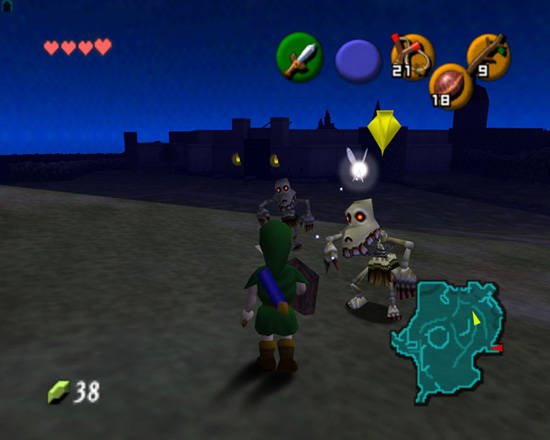
Before its reputation enters the picture, Ocarina of Time has to solve a practical problem: how do you fight with a sword when the enemy can move around you in three dimensions? Z-targeting provides its clearest answer. Lock onto an opponent and Link keeps facing it while you move sideways, raise the shield or dodge. Position and timing become easier to follow because you are no longer trying to steer Link, aim a blow and recover the camera at the same time.
That is the central agreement in the launch reviews. The game brings Zelda’s close-range fighting into 3D without turning it into a platform game built around precision jumping. Attacking, defending and using equipment have distinct jobs. Automatic jumps reinforce that choice: the challenge is usually deciding where to go and what to use, rather than judging the exact moment to press a jump button. It also means someone expecting unrestricted control of every movement may find the system restrictive.
The praise does not mean there is nothing to learn. Context-sensitive actions change according to what Link is facing, and combat asks you to become familiar with several movements. The opening area gives you room to practise before the adventure becomes more demanding. Next Generation also points out a limitation that matters beyond fighting: important objects can sit outside the current view, so the player still needs to adjust the camera. Keeping an enemy in sight and finding something in a room are different problems.
The full set of user texts still contains more favourable assessments of combat and controls than unfavourable ones. Players praise the lock-on, useful defensive moves and bosses that ask them to recognise an opening. The criticism is more specific than ‘old gameplay’: waiting for a shield to drop, repeating the same attack, adjusting the camera or struggling to aim can make an otherwise enjoyable adventure feel slow. Some reviews praise the basic controls and criticise those interruptions in the same paragraph. That is a mixed judgment about fighting, even when the author gives the whole game a very high score.
The combat earns its place in the adventure because targeting lets you concentrate on distance, defence and the tool you need. Its weaker encounters ask for too much waiting once you know the answer. Bosses and more demanding opponents give those actions a purpose; ordinary fights do not consistently sustain that interest. It remains a well-built foundation, with less depth and speed than its reputation might lead a new player to expect.
Critical breakdown
CombatIGN · GameSpot · GameRevolution · Edge · Game Informer · Gamers’ Republic · Hyper · N64 Magazine · Official Nintendo Magazine Italia · Mega Console · Jeuxvideo.com
Player breakdown
CombatClear targeting, useful defence and deliberate timing.
Strong basic controls, with camera or aiming frustrations.
Waiting for openings feels repetitive; movement feels restrictive.
The dungeons ask you to understand a place, not just clear it
A dungeon changes what the game asks of you. Instead of simply reaching the next location, you have to work out how rooms connect, find the right item and understand what it allows you to do. A blocked route might become accessible with the hookshot; a switch or enemy may need a tool acquired elsewhere in the dungeon. Fighting remains part of the process, but progress depends on observing the surroundings and testing an idea. That connection between equipment and space is a major reason the adventure feels coherent.
Dungeons and puzzles also receive predominantly favourable judgments in the user texts that actually discuss them. Players describe distinct temples, equipment worth discovering and the satisfaction of finally understanding a route. The objections pull in different directions: some find the solutions obvious; others get lost, need a guide or dislike repeating rooms. Several enjoy the temples overall while criticising one particular section. The full comparison therefore supports their variety and construction, without turning every complaint into a claim that the puzzles are too difficult. Sometimes the frustration is knowing what to do and having to do it repeatedly.
There was disagreement about the puzzles even at release. GameRevolution found them too simple, while Edge admired their construction but noted that an obvious answer could become harder to spot through overthinking. Those are not the same criticism. One questions whether a puzzle asks enough of the player; the other describes a mismatch between the difficulty expected and the solution actually required. The game can offer a demanding sequence of rooms without making every individual puzzle complicated.
The Water Temple brings the distinction into focus. Changing water levels alters which routes can be used, so the challenge extends beyond the room currently on screen. Supporters enjoy having to build a mental picture of the whole place and make use of the map. Critics describe losing track of where to go, repeating journeys and interrupting play to change equipment. These accounts can coexist: understanding a demanding layout and repeatedly navigating menus are separate parts of the experience.
The iron boots are a concrete example. In the original N64 game, equipping and removing them involves the equipment menu. When a section requires repeated changes, that adds interruptions even if the player already knows the next step. Criticising those interruptions does not prove that the temple’s structure is bad; enjoying the structure does not make the interruptions disappear. Comments about later versions cannot be treated as evidence that the original interface had already solved the problem.
The dungeons make the clearest case for playing Ocarina of Time today: a new tool changes how you understand and move through a place. Returning to a room can then mean discovering a route you could not use before. Reopening a menu adds no comparable discovery. The temples deserve their praise, but the original equipment interface weakens some of their best ideas, especially when changes become frequent.
Critical breakdown
DungeonsIGN · GameSpot · Game Informer · Gamers’ Republic · Hyper · N64 Magazine · Official Nintendo Magazine Italia · Mega Console · Jeuxvideo.com
Player breakdown
DungeonsDistinct temples, useful tools and rewarding spatial puzzles.
Memorable dungeon design, interrupted by repetition or equipment menus.
Repeated key-and-door routines, confusing routes and tedious backtracking.
Hyrule invites detours, but the main quest follows a route
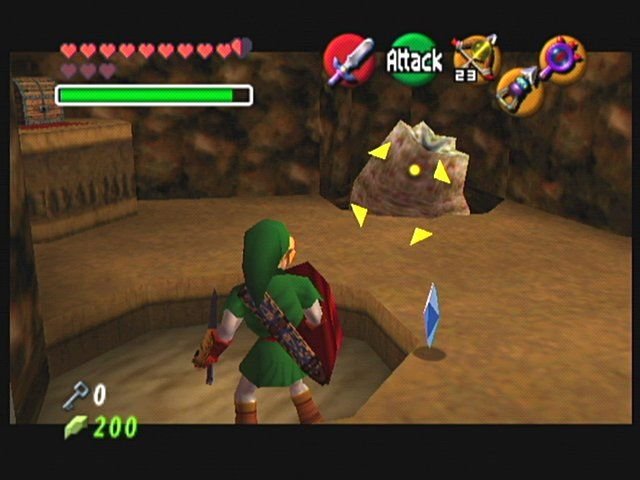
Outside the dungeons, Hyrule gives the adventure breathing room. You travel between settlements, look for optional rewards, try minigames and return to familiar places at a different time of day. The day-and-night cycle changes the mood and some opportunities. Reaching a destination is therefore part of the experience, rather than a transition removed from view. The press often describes the kingdom through that sense of distance and connection: a mountain in the background belongs to the world you are moving through.
Freedom needs to be defined carefully here. The main quest has requirements and a progression that cannot simply be ignored. The flexibility lies in pausing it, exploring nearby places and choosing optional activities. GameSpot explicitly recognises that a largely directed adventure can still create a strong feeling of freedom through its detours. This is useful because it avoids measuring Ocarina against a promise it never actually makes: being able to tackle every part of the story in any order.
Exploration and pacing receive more negative assessments than combat or dungeons in their respective user discussions. Empty stretches of the field, repeated journeys and a slow opening recur alongside praise for secrets, villages, fishing and horse riding. Navi exposes a particular problem: she can interrupt you with advice you already understand while leaving the next required action unclear. Being told how a basic action works does not necessarily help you find your destination. The favourable accounts enjoy taking their time in Hyrule; the critical ones often describe a journey that stops giving them interesting decisions before they reach the next activity.
This disagreement also existed close to release. In a separate contemporary essay, Ito Gabin argues that the succession of tasks and required conditions can make play feel imposed. His objection concerns the freedom to find an approach, not simply the number of available side activities. That essay is not counted as another scored review in the charts, but it usefully challenges the idea that doubts about direction and pacing were invented decades later by people unable to appreciate older games.
The positive user accounts put a different value on the quieter stretches. Riding across Hyrule, returning to a village or listening to the surroundings can give a journey continuity. The same space becomes a problem when someone expects each minute of travel to produce a new encounter or decision. Neither reading requires pretending the field contains the density of a later open-world game. Its size can help sell the scale of the adventure while still leaving some journeys short of interesting actions.
Hyrule succeeds at connecting the adventure and giving its destinations a place in a larger world. Its optional discoveries reward curiosity, but repeated crossings do not always offer enough to do. The biggest weakness comes when a quiet journey ends in uncertainty about the next required step. The game gives exploration a worthwhile purpose; it is less consistent at keeping the journey toward that purpose interesting.
Critical breakdown
ExplorationIGN · GameSpot · GameRevolution · Next Generation · Game Informer · Gamers’ Republic · Hyper · N64 Magazine · Official Nintendo Magazine Italia · Mega Console · Jeuxvideo.com
Player breakdown
ExplorationA connected kingdom, optional discoveries and enjoyable detours.
Strong sense of place, with thin stretches or unclear objectives.
Empty travel, repetitive guidance and overly prescribed progression.
Growing up changes the meaning of places you already know
The story begins with a familiar fantasy task: a young hero leaves home and is drawn into a threat to the kingdom. The more distinctive idea is what happens when Link moves between childhood and adulthood. Seven years do not merely give him a different body and equipment. Familiar places, people and expectations change. The player already knows an earlier version of Hyrule, so returning to it provides a comparison the story does not need to explain entirely through dialogue.
The contemporary praise is strongest when it describes this shift in mood. The early forest feels sheltered and playful; later locations can feel damaged, threatening or strangely distant. N64 Magazine pays particular attention to relationships and the emotional effect of revisiting what seemed familiar. That helps explain why the narrative remains meaningful to users who remember more than the plot’s individual events. A place can carry part of the story because the player has already spent time there.
Story, music and atmosphere form the strongest favourable pattern in the full user analysis. The soundtrack is frequently named even in very short reviews, while longer accounts explain how the time jump, particular characters or returning to changed locations stayed with them. That does not make every part equally strong. Some praise the music but find the plot predictable or the characters underdeveloped; others criticise slow text and interruptions. These are mixed assessments of this combined theme, rather than proof that everyone likes the story. What emerges most clearly is attachment to the world and its sound, with a less consistent enthusiasm for how people talk within it.
Music helps those places acquire an identity. Themes associated with forests, settlements and dungeons give users an easy way to describe what they remember. The ocarina also makes music something the player does: learned tunes affect the world and become part of travelling through it. Sound effects provide another layer, from water and wildlife to changes in how a space sounds. The result is more than a collection of memorable tracks placed behind unrelated actions.
Even here, the launch press was not unanimous. GameRevolution disliked the synthesised music; other reviews admired the compositions while questioning some of the sound or the absence of voiced dialogue. Later users can also dislike the soundtrack or find it ordinary. It would therefore be inaccurate to claim that even the game’s harshest critics agree about the music. What survives strongly across the favourable accounts is its connection to particular places and actions, rather than an uncontested judgment about every tune.
The strongest storytelling happens when a place you remember has changed and you understand what those years have cost. Music helps that feeling survive beyond a particular scene. This gives the adventure emotional weight even with a familiar plot, although it cannot make thin dialogue richer. Story and sound work well together; the best reason to recommend them is that connection, rather than a promise of unusually complex writing.
Critical breakdown
Story and musicIGN · GameSpot · Edge · Game Informer · Gamers’ Republic · N64 Magazine · Official Nintendo Magazine Italia · Mega Console
Player breakdown
Story and musicMemorable music, changing places and an affecting child-to-adult journey.
Strong atmosphere, with conventional plot or uneven dialogue.
Thin characters, slow storytelling or an unremarkable soundtrack.
The original presentation still has character, but its limits matter
Walk out into Hyrule and you can see a mountain that belongs to the adventure ahead. Day turns to night, locations have different colours and silhouettes, and the journey connects them. That is much of what impressed the launch reviewers: the world felt larger than the room currently on screen. Its appeal was never only the detail of a texture. Today those recognisable places can still draw you in, even when the models and surfaces no longer look impressive.
The press did notice limitations. Blurred textures, less convincing static backgrounds in some interiors and occasional slowdown appear in the contemporary discussion. Hyper is particularly useful because its enthusiasm for the adventure does not depend on calling every visual detail the best available on N64. The game’s coherence and atmosphere can outweigh a rougher surface. This is a more informative judgment than either treating launch praise as proof of timeless graphics or assuming old graphics cancel everything that praise described.
The user texts contain substantial criticism of graphics and technical presentation as well as praise. Some admire the colours, character designs and atmosphere of particular locations; others find the models, textures or movement hard to enjoy today. A third group explicitly admires what the game achieved on N64 while acknowledging that its appearance has aged. Those judgments need their context. ‘Impressive in 1998’ and ‘pleasant to look at now’ answer different questions. Reports of poor performance also cannot establish a common cause when the reviewer leaves the hardware or edition unidentified. We can describe the difficulty reported without inventing an explanation for it.
Nostalgia explains some of the attachment, but not all of it. The user texts include childhood memories, later discoveries and replays that changed an earlier opinion. There are players who arrived years after release and loved it, as well as returning fans who found it slower than they remembered. These accounts leave no useful rule that age determines enjoyment. They also show why historical importance and current enjoyment deserve separate judgments: accepting that Ocarina mattered does not oblige anyone to prefer playing it to a later adventure.
The art still gives Hyrule a clear identity, while the original textures and performance ask more patience of someone arriving today. Those limits should be acknowledged without declaring the game unplayable or demanding that players ignore them. Its appearance supports a rewarding adventure; it no longer supplies the same immediate surprise that the launch reviews describe. The dungeons and atmosphere must now carry more of the recommendation.
Critical breakdown
PresentationGameSpot · GameRevolution · Edge · Next Generation · Game Informer · N64 Magazine · Official Nintendo Magazine Italia · Mega Console · Jeuxvideo.com
IGN · Hyper · Gamers’ Republic
Player breakdown
PresentationDistinctive colours, designs and locations remain appealing.
Admiration for the original achievement alongside visible ageing.
Old textures, models or reported performance hinder enjoyment.