

The Legend of Zelda: Ocarina of Time: What 1998 Critics and Later Players Think
8 professional reviews cross-referenced with 1 contemporary Japanese editorial outlier and 2,697 Metacritic user reviews with text · user corpus through 10 September 2026
Ocarina of Time’s reputation was not invented by hindsight. Critics in 1998 already identified the 3D transition, Z-targeting, contextual controls, Hyrule’s spatial coherence, and real-time staging as major advances. Decades of user reviews broadly preserve that admiration, but they also place more weight on the friction that contemporary critics had only begun to notice: camera management, guidance, linear progression, slow traversal, menu interruptions, and combat whose lock-on structure can now feel more cautious than dynamic.
Consensus map
What survived from 1998 into the retrospective debate
| Aspect | 1998–99 press | Later Metacritic users | Relationship |
|---|---|---|---|
| 3D transition and Z-targeting | Recognised immediately as a major design breakthrough | Still widely treated as historically foundational | Strong agreement |
| Camera and controls | Mostly successful, with some adjustment and occasional friction | A much more visible source of age and frustration | Same phenomenon, greater later weight |
| Freedom and progression | Expansive world, but guidance and linearity were already noticed | Split between satisfying exploration and an empty or over-directed Hyrule | Early tension amplified over time |
| Dungeons and puzzles | Highly praised, but difficulty was already disputed | Still central to praise; Water Temple and puzzle logic remain divisive | Broad continuity |
| Navi and guidance | Useful interface for some; intrusive or restrictive for others | The annoyance became culturally iconic, though not universal | Later emphasis, not a newly invented flaw |
| Graphics and performance | Spectacular overall, with blur, static interiors, or slowdown noted at the margins | Frequently described as visibly dated, especially on original N64 presentation | Technical aging changes the weight |
| Music and atmosphere | One of the game’s defining strengths despite some MIDI reservations | Among the most consistently durable positives | Strong agreement |
The player column reflects the full exported corpus of 2,697 Metacritic user reviews with text on the Nintendo 64 page, dated from 16 November 2010 to 10 September 2026. The corpus is self-selected and is not statistically representative of all players; two exported records without review text were excluded.
The revolution was visible in real time
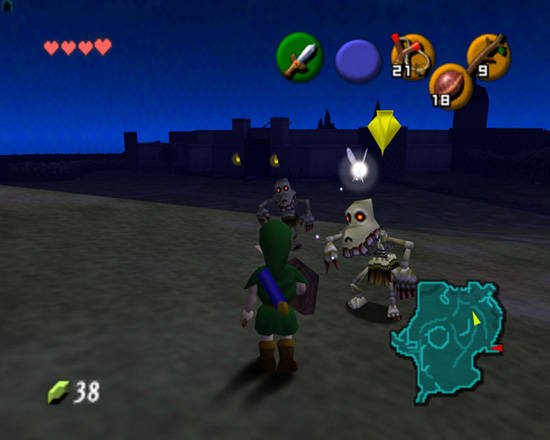
The most important conclusion from the contemporary reviews is that Ocarina of Time’s historical importance does not need to be reconstructed from later reputation. IGN explicitly presents Z-targeting as a solution other 3D games are likely to adopt. Game Informer explains how locking onto enemies enables sidesteps and backflips while the move into three dimensions changes the way players read puzzle spaces. Gamers’ Republic and GameSpot likewise treat the targeting system and contextual controls as central to making a 3D Zelda feel natural rather than cumbersome.
Edge makes the broader point especially well. Its 10/10 review argues that Nintendo avoided turning Zelda into a fantasy variation on Super Mario 64: exploration, combat, puzzles, music, and staging still belong to the identity of the series, but now operate inside a new spatial language. Even the strongly dissenting Ito Gabin article for HotWired Japan recognises camera handling, targeting, interface design, tutorials, and scene construction as problems Nintendo tackled in ways the rest of the industry could learn from.
The Metacritic corpus preserves this argument more clearly than almost any other. Later users repeatedly describe the game as foundational, influential, ahead of its time, or a blueprint for later 3D adventures. The more revealing reviews are those that dislike how it plays now yet still concede its historical importance. That separation between influence and enjoyment becomes one of the defining features of the retrospective debate.
Hyrule felt free before it was ever truly open
Contemporary enthusiasm for Hyrule often rests on the sensation of freedom rather than on a claim that the game is structurally non-linear. GameSpot celebrates the freedom to explore while acknowledging that substantial parts of the adventure must still be completed in a prescribed order. GameRevolution similarly observes that the player can wander, but that the story and Navi keep steering Link back toward the intended route.
Edge makes the tension explicit even while awarding 10/10: some text-heavy guidance can impose an unwanted linearity on what otherwise feels like an open structure, although the same guidance can be welcome when the player genuinely needs direction. Ito turns that tension into a central objection. For him, the world promises freedom, but the role-playing structure repeatedly reduces that freedom to a set of required tasks and predetermined answers.
Later users divide on exactly the same axis, but with a new spatial criticism. Positive reviews still describe leaving Kokiri Forest for Hyrule Field as a defining moment of scale and possibility. More critical reviews call the field sparse, empty, or slow to cross and argue that later open worlds have changed what players expect from large spaces. This is not a simple reversal of the 1998 consensus. It is the same distinction — freedom as sensation versus freedom as structure — judged after nearly three decades of open-world design.
Dungeon design endured; difficulty never had one consensus
The idea that Ocarina of Time’s puzzles were unanimously regarded as difficult in 1998 does not survive contact with the original reviews. Game Informer and Gamers’ Republic find the more advanced puzzles genuinely demanding, while the four short Famitsu Cross Review verdicts emphasise the satisfaction of solving them. GameRevolution is much less convinced, describing the game as lengthy without equating that length with depth. Edge sits between those positions: its puzzles are ingenious, but some are so simple that a player may miss the obvious answer by assuming the solution must be more elaborate. Ito is more severe still and treats many of the riddles as banal.
The retrospective corpus reproduces the disagreement almost exactly. Dungeon identity, item-based progression, bosses, and puzzle variety remain some of the most common reasons users give for loving the game. At the same time, critical and mixed reviews complain about repetitive key-and-door structures, unclear logic, or puzzles whose difficulty comes from navigation rather than deduction.
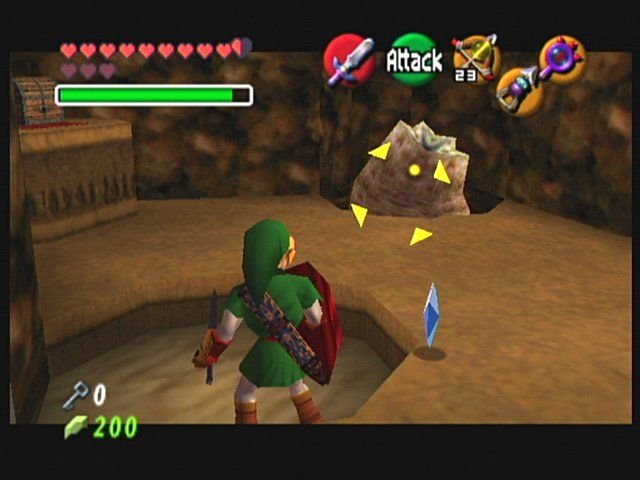
The Water Temple has become the emblem of that dispute. Later reviews often criticise not only its spatial logic but the original N64 interface around it: repeatedly opening the menu to equip and remove the Iron Boots is remembered as friction in a way the contemporary corpus does not foreground. This is an important retrospective distinction. The underlying dungeon design was already divisive; the interface cost of navigating it became more visible once later hardware and later versions showed how easily that friction could be reduced.
What aged is less the idea than the friction around it
Camera and controls were not invisible problems in 1998. Next Generation, despite its 5/5, says the viewpoint still needs frequent manipulation and that combat in three dimensions takes some adjustment. IGN notes a learning period and occasional contextual-action mistakes. Game Informer and GameRevolution are more positive, especially compared with earlier 3D games, and treat the camera as a major improvement rather than a structural flaw.
Later players give those same issues more weight. The exported reviews repeatedly return to aiming, camera behaviour in confined spaces, low frame rate, slow walking, unskippable or slow dialogue, and the pause-menu interruptions created by equipment changes. A related criticism reframes Z-targeting itself: what 1998 critics saw primarily as an elegant answer to 3D combat can now be described as a pattern of shielding, waiting for an opening, attacking, and repeating.
This is why “revolutionary for its time” functions in the user corpus in two opposite ways. For some players it explains why the game remains compelling despite visible age. For others it is a historical fact that should not protect the experience from present-day criticism. The split is not between people who understand the game’s influence and people who do not; many of the most negative reviews explicitly acknowledge that influence before rejecting it as a reason to enjoy the game today.
Navi became a symbol larger than the original criticism
The modern reputation of Navi as an irritation has genuine contemporary roots, but the 1998 evidence is mixed. IGN already includes her repeated “Hey!” calls among the game’s minor annoyances. GameRevolution links Navi to the way the adventure keeps the player near its intended path. Game Informer, by contrast, presents her positively as part of the interface: she identifies people, objects, and enemies and can provide useful information. Edge criticises intrusive guidance more broadly without reducing the issue to the fairy herself.
Metacritic users amplify the negative side until Navi becomes shorthand for hand-holding, repeated interruption, and obvious hints. Yet the corpus also contains plenty of reviews that barely object to her or explicitly say the annoyance is overstated. The retrospective consensus is therefore not “Navi was always a design failure.” A more accurate reading is that an already documented irritation became culturally magnified because later games made repeated prompts and forced guidance easier to recognise as a design choice rather than an unavoidable part of early 3D usability.
Music and atmosphere aged better than the presentation
Visual praise in 1998 was enormous, but not blind. IGN notices blurred textures and performance that is not always the strongest on Nintendo 64. GameSpot records occasional slowdown. Next Generation finds some static interior backgrounds weaker than the outdoor world, and Gamers’ Republic notes soft textures and a few prerendered elements that sit awkwardly beside the real-time presentation. Edge also identifies static or pseudo-scrolling interiors as a relative low point.
Later users understandably treat these technical compromises more harshly. Low resolution, texture blur, frame rate, sparse geometry, and the original controller layout are frequent markers of age. Reviews that compare the N64 version with the 3DS remake or later ports were not used to transfer remake-specific improvements back onto the 1998 original; when such reviews discuss the original, only those original-version observations inform this comparison.
Music is far more stable. GameRevolution dislikes the MIDI quality, IGN finds some samples dated, and Next Generation does not consider every piece equally memorable, but the integration of the ocarina and environmental audio receives substantial contemporary praise. In the user corpus, the soundtrack, Song of Storms, field and town themes, and the connection between music and memory recur as some of the strongest positive signals even in reviews that are otherwise critical of how the game has aged.
Nostalgia shapes the argument, but it does not explain the verdict
Later reception adds a theme that could not exist in 1998: Ocarina of Time is no longer merely a game but a canonised object. User reviews repeatedly argue over “greatest of all time,” “overrated,” childhood memory, historical importance, and whether an old game should be judged by 1998 standards or by the standards of the day it is replayed.
The corpus does not support reducing praise to nostalgia. It includes highly positive reviews from players who say they first encountered Ocarina years after release, as well as younger players who explicitly distinguish their admiration from N64-era memory. At the same time, it contains equally clear first-time or low-nostalgia reactions that find the controls, pacing, combat, or world structure too dated to enjoy. Nostalgia is therefore part of the reception environment rather than a sufficient explanation for either side.
This also puts Ito Gabin in the correct place. His 7/10 from January 1999 shows that a player could recognise Nintendo’s technical and design advances almost immediately and still reject the idea that those advances produced a near-perfect game. Later sceptical reviews often make a similar separation, but Ito remains an outlier because the broader contemporary professional consensus gave the same tensions far less weight.