The Book of Prosperity is a 2D action RPG that mixes timing-based combat, platforming and a story that moves between mystery and comedy. Its free Steam demo has plenty of ideas, but they don’t all come together equally well. Parrying already feels reliable and the writing has plenty of character. Moving through the world is another matter: the protagonist seems to float above the ground, while a handful of school minigames interrupt the adventure more than they help it. There’s something worth following here, but the controls still need work before the action can match the personality of the storytelling.
Developed by Hong Kong solo creator SingKeys, the game follows Cyrus, a student who ends up in a parallel dimension controlled in part by The Circle, an organization with an interest in manipulating people’s memories. Its world brings Hong Kong-inspired streets together with fantasy settings and a cast of exaggerated characters. That premise sounds fairly dark, yet the tone rarely stays serious for long. Ordinary school situations take on an absurd quality, and the game enjoys poking fun at its own characters without discarding the mystery at the center of the story.
The writing is where the demo makes its strongest impression. Conversations have good comic timing, the characters work as playful caricatures, and the shifts from jokes to adventure feel natural. The cast gives you a reason to see what happens next, rather than simply filling the gaps between fights. Colorful pixel art, expressive portraits and a cartoon-inspired visual direction are just as important to that effect. The Book of Prosperity is at its best when its humor, expressive characters, and art direction all work together. That’s a strength you can appreciate in the demo itself, without having to take the finished game’s ambitions on trust.
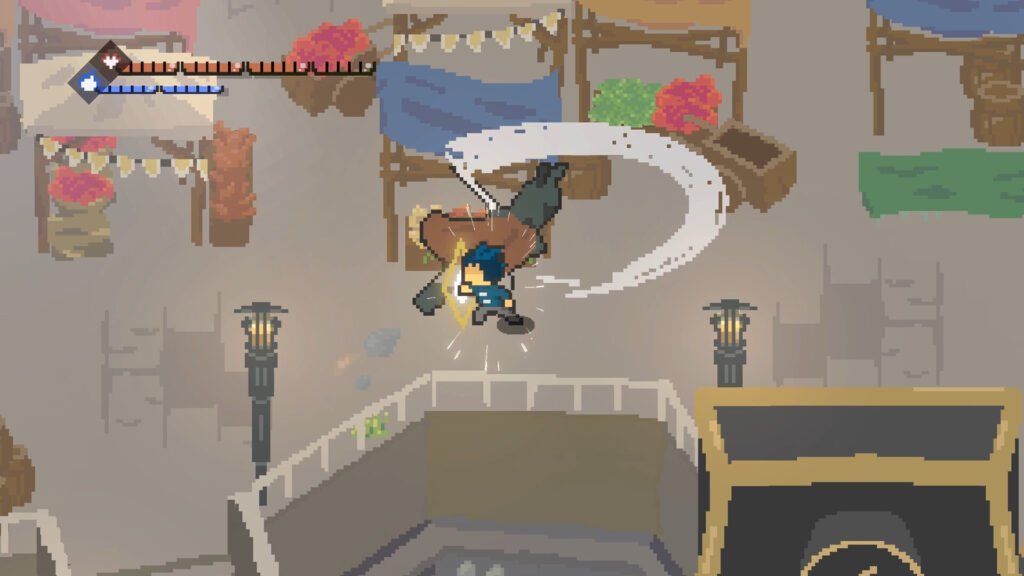
Combat is in better shape than the traversal. Enemy animations make attacks fairly easy to read, so you can react to what you’re seeing rather than guess when to defend. Parries feel dependable and the timing window is generous enough to avoid demanding frame-perfect precision. This is also why the Soulslike comparison doesn’t really fit the experience on offer. Timing matters, but the constant pressure and unforgiving precision often associated with that label aren’t present to the same degree here. The system is more approachable, and successfully turning an enemy’s attack aside still feels satisfying.
There’s some added texture from rhythm-based combos. A circular prompt appears during certain attacks, and hitting the input at the right moment lets you chain moves while making better use of your resources. It encourages paying attention to the rhythm of a fight instead of button-mashing. The defensive side of combat feels the most convincing so far. Hit feedback, however, could be stronger. Attacks work well enough, but they don’t always deliver the weight suggested by their presentation. More enemy types and abilities may help sustain the combat over a longer game, provided they build on the solid timing mechanics already in place.
Movement is the demo’s biggest weakness. Cyrus travels across the screen at a speed that doesn’t match his running animations, making him look as though he’s sliding or hovering over the ground. Occasionally that suits the exaggerated cartoon aesthetic, but much of the time it just feels unfinished. This isn’t merely a visual complaint. In a game that advertises quick traversal and platforming as important parts of the experience, the impression that your character has real weight matters. Even when the inputs respond correctly, crossing an environment should feel more grounded and convincing than it currently does.
Jumping has much the same issue, although there’s an important difference between how it looks and how it controls. Cyrus can feel almost weightless in midair, but the amount of aerial control is actually quite good. Adjusting a jump is straightforward, and there aren’t obvious precision problems to compensate for. Rather than rebuilding the input system, the developer should focus on how movement speed and animation work together. That could improve the feel of traversal without losing the freedom to adjust your path through the air.
The school minigames are less successful. They make sense as a change of pace in such a playful story, but they interrupt the flow between dialogue, exploration and combat. One especially awkward activity asks you to erase a blackboard as quickly as possible. With a mouse, you can move the pointer as fast as your hand allows. With an analog stick, the cursor has a fixed speed limit, creating a disadvantage tied to your input device rather than your skill. An update added an option to skip these minigames. That helps players avoid frustration, but it doesn’t make the activities themselves more enjoyable or better integrated.
The Book of Prosperity has an appealing sense of humor, a lively art style and a combat system with a dependable foundation. Still, the movement issues shouldn’t be treated as a minor polish task. That floating sensation follows you throughout exploration and makes even otherwise accurate controls less enjoyable. Better animation synchronization, more convincing hit feedback and a rethink of the minigames would help the full game make much better use of its strongest ideas. For now, it’s a creatively appealing project with a distinctly uneven action experience.