RANGER COMMANDO is the kind of game that gets you enjoying yourself within the first few firefights, then starts showing its weaknesses once you’ve played a handful of missions. It’s an isometric military shooter developed by former Guerrilla Games developer Dirk Boer, drawing on the action games and movies of the 1980s. Procedurally generated maps, changing objectives and straightforward combat are the main ingredients. You enter hostile territory, push through enemy positions, complete tasks such as freeing hostages or sabotaging installations, and try to make it out alive. The free Steam demo reveals a clear divide between shooting that already feels good and missions that don’t yet offer enough different situations to support it.
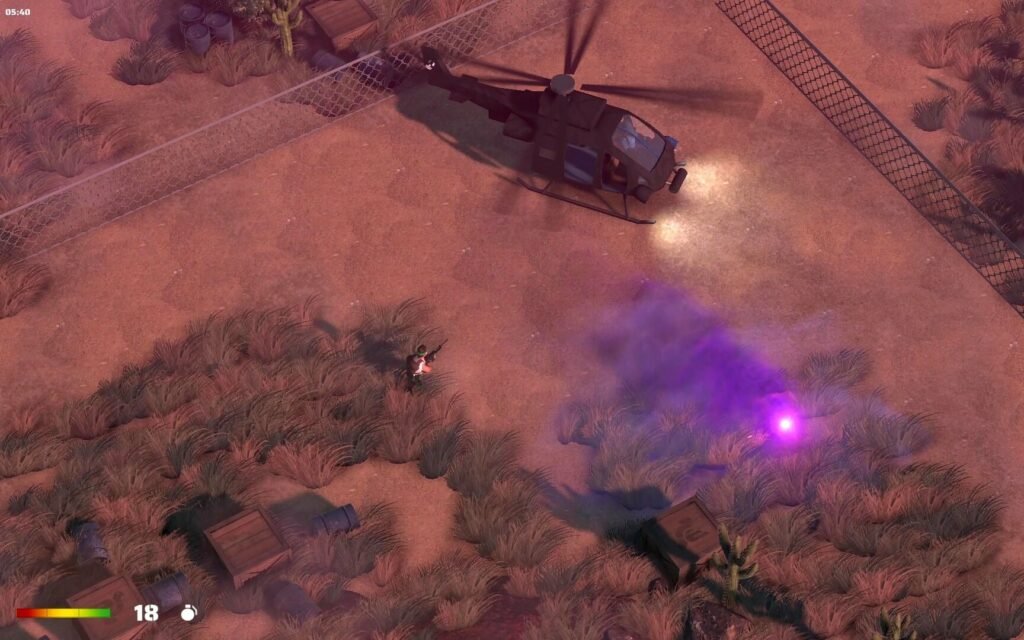
Guns are easily the highlight. Shooting in RANGER COMMANDO is already a blast: the weapons have real character, and its arcade combat has found its rhythm. Switching weapons noticeably changes how a fight feels, while the shots have satisfying weight and presence. The generous aim assistance deserves some credit. Point in roughly the right direction and get an enemy within your firing angle, and you’ll usually land the shot. That might sound overly forgiving, but this isn’t trying to be a military simulator. Requiring pinpoint accuracy from an overhead camera would turn quick encounters into an exercise in adjusting the reticle. Instead, moving, aiming and firing work together naturally. The controls are responsive, and the result is combat that understands the appeal of an old-school arcade shooter.
The ammunition system adds a welcome decision to that fast action. When you reload, you throw away any rounds left in the magazine. You can’t automatically reload after every encounter without paying a price. You might choose to fire the last few bullets before swapping magazines, or sacrifice them because you don’t want to enter the next fight nearly empty. That adds a tactical choice without bogging the action down in equipment menus.
Enemy behavior is much less convincing. Soldiers notice your presence and attempt to take cover, but they rarely show more advanced tactics or try to surround you. There are, however, a few touches worth keeping. Wounded enemies can crawl along the ground in an attempt to get away, leaving you free to finish them off or let them go. You’ll also encounter non-hostile doctors and scientists, and the choice to shoot them is yours. Pathfinding is the bigger concern. Enemies sometimes get stuck or seem unable to find a route towards you, making encounters easier and less believable than they should be.
Procedural generation should help the missions stay fresh, yet right now it mainly changes objectives and the placement of elements. One assignment might ask you to interact with something different, but the actual routine barely changes. You move forward, shoot whoever gets in the way and reach the next objective. Simplicity itself isn’t the issue; it suits the game’s arcade ambitions. What’s missing are situations that make you use the same weapons and movement skills differently. More varied obstacles, meaningful routes through a level and objectives that change how you approach a mission would do much more for replayability than simply replacing one interactive object with another.
The environments also need work. There’s a limited selection of assets, level layouts can feel basic, and the ground textures are especially rough. Sound effects do a good job supporting the gunfire, while character animations are serviceable rather than impressive. There isn’t a soundtrack in the demo, which leaves the quieter stretches feeling bare. The overhead perspective does introduce an appealing wrinkle. Sometimes you can’t immediately tell where an incoming shot came from, so you have to move and find the attacker. That uncertainty doesn’t necessarily feel unfair; it gives you a reason to reposition and pay attention to your surroundings. Responsive controls help ensure those moments don’t become frustrating.
What remains is a promising core surrounded by systems that need more time. Better pathfinding and more polished environments would address the most obvious weaknesses, but lasting replayability will depend on the mission design. A wider pool of objectives would only help if those objectives lead to genuinely different encounters, routes and decisions. If what you want is immediate arcade action with satisfying firearms, there’s already a lot to like about RANGER COMMANDO’s shooting. If you’re hoping procedural generation will keep every run interesting, the demo doesn’t make that case yet.