VCR83 has a free demo on Steam, and its premise begins with a familiar horror routine: watch surveillance feeds, identify anything that has changed, and survive the shift. The distinguishing feature of this game, developed by Tarba Paul Cornel and published by Galactic Crows, happens beyond the cameras. Certain events can reach into the player’s Windows desktop, while a virtual assistant named Pete seems increasingly interested in the person controlling the game. VCR83 has a compelling central idea: the screen is not just a window into the horror, but part of the horror itself.
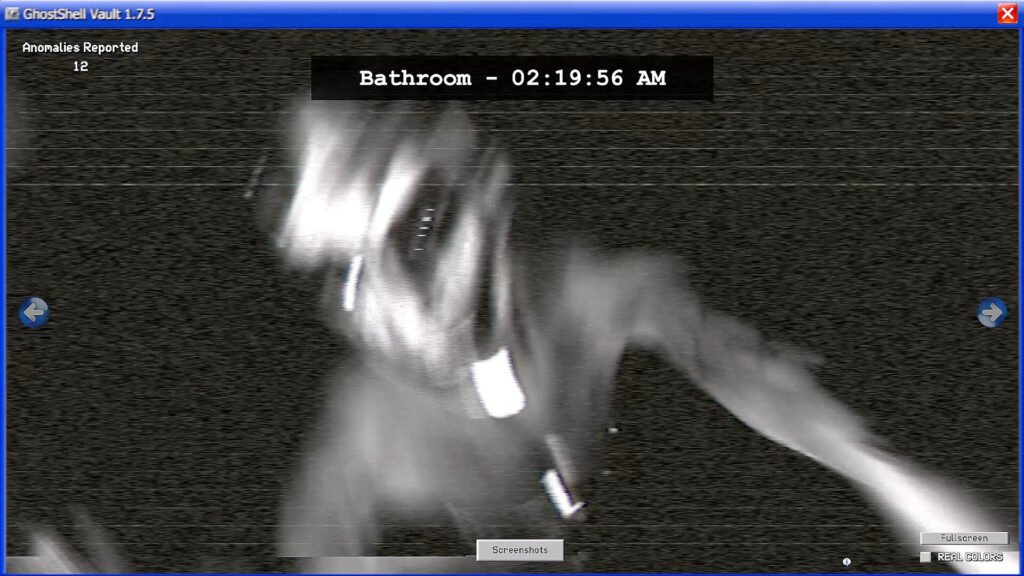
Observation is still the core of every shift. Players study the rooms shown by the cameras, learn where objects belong and click on anything that no longer looks right. Players must also remember whether a detail has actually changed. Even when nothing obvious is happening, each return to a camera feed asks the same uncomfortable question: do you really remember what was there? VCR83 uses that gap between seeing and remembering as the foundation of its tension. Players must build a mental picture of each space rather than rely on a quick glance, so ordinary objects matter as much as the unusual ones.
Correct anomaly reports award Tokens, which are used to unlock more levels and advance the story. Pete adds another layer to this progression. Players can speak with the virtual assistant, ask questions and even persuade him to sing. He responds to how shifts have gone and retains details that might initially seem insignificant. Pete makes an unsettling idea out of something normally reassuring: having someone there to keep you company. Even Pete’s friendliness can become suspicious.
The Windows integration is the clearest departure from the usual surveillance-horror structure. Some scripted events can create folders, interact with Windows Search or launch an application such as Paint. Other events can draw on Steam friends information and location details to make particular encounters feel more personal. The line between fictional interface and real machine becomes less clear. VCR83’s most distinctive move is turning the desktop from the place you play into part of the stage.
Those boundaries deserve attention before anyone enables the relevant features. The build described by the creators requests administrator privileges for its Windows integration. Galactic Crows states that it neither receives nor stores players’ locations or Steam friends lists on its own servers. Some features nevertheless involve the embedded browser, Windows location services and third-party services governed by their own data policies. Most of the browser’s pages are local files, while external navigation is limited to YouTube, X, Twitch, Instagram and the studio’s website. The permitted sites may still set cookies or collect information. These are the creators’ explanations of how the game handles data, not the findings of an independent security audit.
An October 6 demo update introduced Streamer Mode to help people recording or broadcasting gameplay avoid exposing personal information. With the setting active, the player’s Steam name is replaced with a fictional identity, their profile picture is hidden, and the event capable of displaying an address is disabled. It can be selected when launching the game or changed later through Tools > Settings. Automatic detection of software such as OBS cannot cover every capture setup, making direct control useful. It also avoids treating software detection as a substitute for an explicit privacy choice, especially when creators use different recording tools or setups.
The full release is planned to feature four locations, each with distinct cameras, anomalies, secrets and story material. Easy, Normal and Hard difficulty settings are listed alongside Real Time, Shuffle and Dark modes. These features are planned for the full game, not necessarily included in the demo. Another component is Aftermath, a playable sequence of roughly three to five minutes attached to each level. Players revisit monitored rooms to discover what happened once recording stopped. These brief sequences make the locations more than static backgrounds and let players connect what they saw on a camera with what actually followed in those rooms. There is something genuinely appealing about finally stepping inside rooms you have learned to recognise only through a camera.
VCR83 is scheduled for PC in the fourth quarter of 2026, although an exact release date has not been announced. English voice audio is listed, with Italian among the supported interface and subtitle languages. Minimum specifications include 64-bit Windows 10, 8 GB of RAM, a GeForce GTX 1650 or Radeon RX 6500 XT, and 10 GB of storage. Further information is available on the official website for VCR83.